Wednesday, May 9, 2018

Renting Out an In-Law Unit: Pros and Cons for Homeowners Hoping to Turn a Profit

An in-law unit can be a major selling point when you're buying a house. It's the perfect guesthouse for short-term visits (your adult children coming for Christmas) or long-term stays (Grandma moving in with you). But what can you do with your in-law unit while it's sitting empty? Some homeowners opt to rent it out.
Nothing sounds sweeter than extra monthly cash flow, but is it really that simple? Let's dive into the pros and cons of renting out your in-law unit and what you can expect to deal with as a property manager.

What is an in-law unit?

To qualify as an in-law unit, this part of the house should have its own entrance, bathroom, and kitchen or kitchenette, says Stephanie Trevizo, a real estate agent and landlord in Los Angeles.
If your home listing says it comes with an in-law unit, you should make sure it legally qualifies as one in your municipality.
"This can usually be done by calling your local housing authority or city," Trevizo says.

Benefits of renting out an in-law unit

As Trevizo points out, homeowners stand to make extra income with a space they're not already using, and they can do so with relatively little intrusion on their everyday lives. Because of their separate entrance, in-law units offer homeowners privacy and a sense of distance from their renters, something that wouldn't happen if you were renting out a room in your home.
In-law units are also attractive to renters, which can make it easier for you to find a tenant. Because an in-law unit is part of a home, it's likely located in a community largely made up of single-family homes.
"Some [renters] choose these types of units to get into certain school districts," Trevizo notes. "The landlords tend to be more flexible than a management company at an apartment complex."
What's more, if you've already furnished your in-law unit for visits from your guests, you have the advantage of being able to list it as a furnished unit for short-term rental on sites such as Airbnb or HomeAway.
Then again, the separate entrance and all-in-one amenities (e.g., private bathroom and kitchen) make most in-law units great for extended-stay rentals as well, says Rob Stephens, co-founder and general manager of Avalara MyLodgeTax, a company that provides lodging tax compliance solutions for property managers.
If you know the unit will sit vacant for a while, an in-law unit can be turned into a more traditional rental, with long-term monthly or even yearly leases.

Disadvantages of in-law unit rentals

Before renting out your in-law unit, you must ask yourself if you're ready to deal with a tenant in your personal space. Separate entrance and bathroom aside, the tenant will still be living on your property, so you're both certainly going to have some personal interaction at some point.
There are also a few other questions to consider, says Kimberly Smith, a broker with AvenueWest Global Franchise, in Denver. For example, will the tenants' noise bother you or your noise bother them? Will you feel safe? Are you comfortable renting to someone with a pet? Do you have enough room for them to park their car, or will that require daily communication?
Because renting out an in-law unit is legally equivalent to renting out any other piece of property, you do need to follow the laws of your local municipality, Stephens says. In the case of a short-term rental such as an Airbnb, you may be required to collect occupancy taxes, register guests, and sometimes obtain a license from your local authorities.
"Requirements to register and the occupancy tax rate that needs to be collected vary by city, county, and state across the U.S.," Stephens says. "In some areas, you may only need to complete one registration form and remit taxes to one tax agency. In other markets, there are usually three to four different registrations that need to be completed, which include some form of licensing with the separate city, county, and state agencies. In about half the markets across the U.S., you will need some form of business or rental license. In other markets, you simply need to register and pay the occupancy taxes, not obtain a license."
In other words, you'll need to check with the city, county, and state where your home is located before you decide to become a landlord, even if it's for the short term.
Renting out your in-law unit could also have an effect on your homeowner insurance policy, so it's important to call your insurance agent before you put up that rental ad. Because renting is defined as a business activity, your typical homeowner policy will not cover losses related to your rental, Stephens warns.
One final consideration, and this is a big one: the responsibility that comes with maintaining a property.
"This could mean late-night phone calls about problems the tenants are having with the home," Trevizo warns.
As the property manager, you'll be on the hook for a number of things, including collecting rent, setting lease terms, handling repairs and emergencies, dealing with security deposits, and filing taxes on the property.
"There is always the risk that you may have to evict a tenant, which could be costly and time-consuming," Trevizo says.
Contact The McLeod Group Network for all your Real Estate needs! 971.208.5093 or mcleodgroupoffice@gmail.com.
By and photo credit: Realtor.com, Jeanne Sager

Tuesday, May 8, 2018

Home Inspections: What to Expect

So you made an offer, it was accepted, and now your next task is to have the home inspected prior to closing. Oftentimes, agents make your offer contingent on a clean home inspection.
This contingency allows you to renegotiate the price you paid for the home, ask the sellers to cover repairs, or even, in some cases, walk away. Your agent can advise you on the best course of action once the report is filed.

How to Choose an Inspector

Your agent will most likely have a short list of inspectors that they have worked with in the past that they can recommend to you. HGTV recommends that you consider the following 5 areas when choosing the right home inspector for you:
  1. Qualifications – find out what’s included in your inspection and if the age or location of your home may warrant specific certifications or specialties.
  2. Sample Reports – ask for a sample inspection report so you can review how thoroughly they will be inspecting your dream home. The more detailed the report, the better in most cases.
  3. References – do your homework – ask for phone numbers and names of past clients who you can call to ask about their experiences.
  4. Memberships – Not all inspectors belong to a national or state association of home inspectors, and membership in one of these groups should not be the only way to evaluate your choice. Membership in one of these organizations often means that continued training and education are provided.
  5. Errors & Omission Insurance – Find out what the liability of the inspector or inspection company is once the inspection is over. The inspector is only human after all, and it is possible that they might miss something they should have seen.
Ask your inspector if it’s okay for you to tag along during the inspection, that way they can point out anything that should be addressed or fixed.
Don’t be surprised to see your inspector climbing on the roof or crawling around in the attic and on the floors. The job of the inspector is to protect your investment and find any issues with the home, including but not limited to: the roof, plumbing, electrical components, appliances, heating & air conditioning systems, ventilation, windows, the fireplace and chimney, the foundation, and so much more!

Bottom Line

They say ‘ignorance is bliss,’ but not when investing your hard-earned money into a home of your own. Work with McLeod Group Network, who you can trust to give you the most information possible about your new home so that you can make the most educated decision about your purchase. 971.208.5093 or mcleodgroupoffice@gmail.com.

By: KCM Crew

Thursday, May 3, 2018

4 Reasons Why Today’s Housing Market is NOT 2006 All Over Again


With home prices rising again this year, some are concerned that we may be repeating the 2006 housing bubble that caused families so much pain when it collapsed. Today’s market is quite different than the bubble market of twelve years ago. There are four key metrics that explain why:
1.    Home Prices
2.    Mortgage Standards
3.    Mortgage Debt
4.    Housing Affordability
1. HOME PRICES
There is no doubt that home prices have reached 2006 levels in many markets across the country. However, after more than a decade, home prices should be much higher based on inflation alone.
Frank Nothaft is the Chief Economist for CoreLogic (which compiles some of the best data on past, current, and future home prices). Nothaft recently explained:
“Even though CoreLogic’s national home price index got to the same level it was at the prior peak in April of 2006, once you account for inflation over the ensuing 11.5 years, values are still about 18% below where they were.” (emphasis added)
2. MORTGAGE STANDARDS
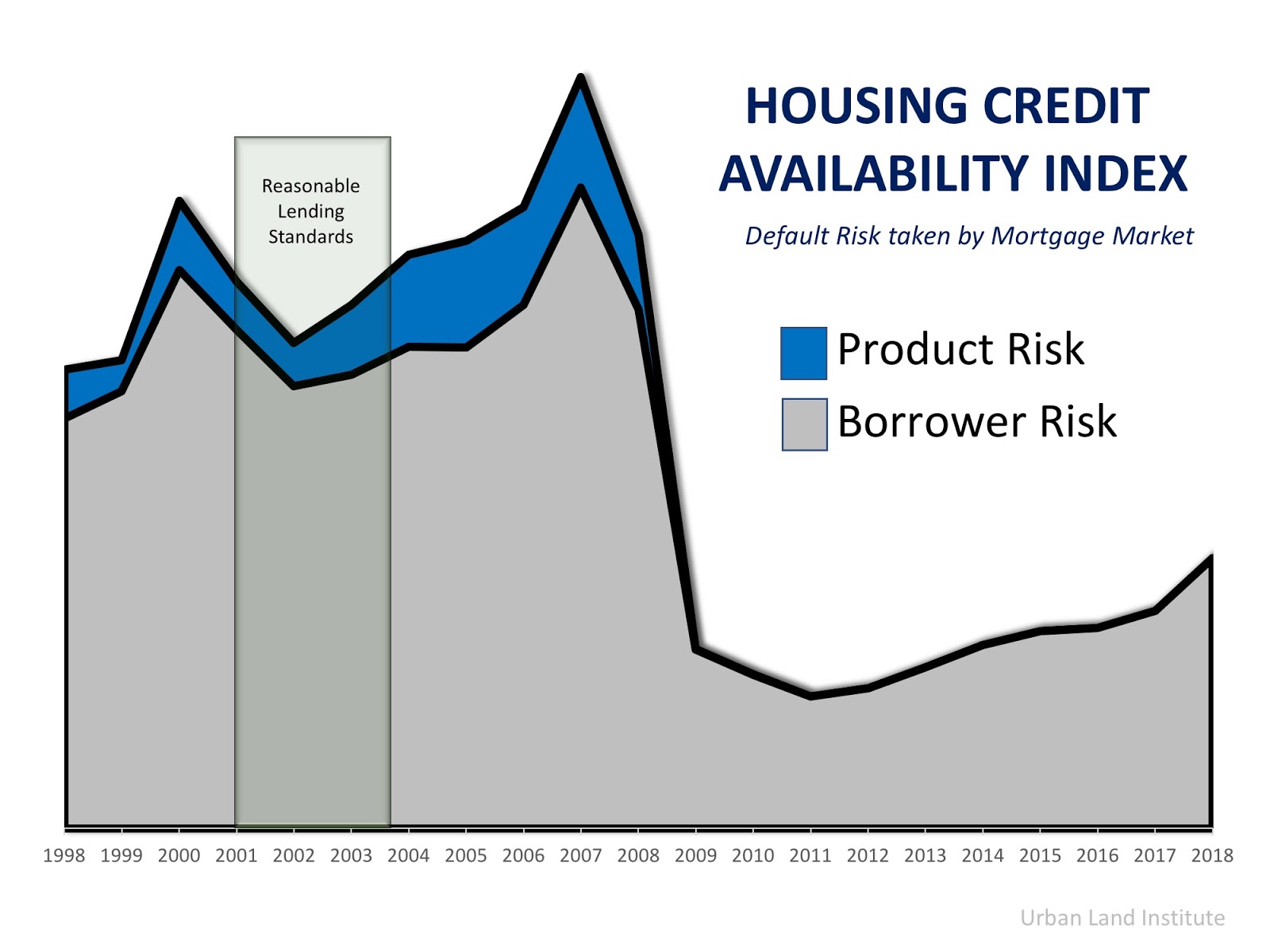
Some are concerned that banks are once again easing lending standards to a level similar to the one that helped create the last housing bubble. However, there is proof that today’s standards are nowhere near as lenient as they were leading up to the crash.
The Urban Institute’s Housing Finance Policy Center issues a Housing Credit Availability Index (HCAI).According to the Urban Institute:
“The HCAI measures the percentage of home purchase loans that are likely to default—that is, go unpaid for more than 90 days past their due date. A lower HCAI indicates that lenders are unwilling to tolerate defaults and are imposing tighter lending standards, making it harder to get a loan. A higher HCAI indicates that lenders are willing to tolerate defaults and are taking more risks, making it easier to get a loan.”

The graph below reveals that standards today are much tighter on a borrower’s credit situation and have all but eliminated the riskiest loan products.

3. MORTGAGE DEBT

Back in 2006, many homeowners mistakenly used their homes as ATMs by withdrawing their equity and spending it with no concern for the ramifications. They overloaded themselves with mortgage debt that they couldn’t (or wouldn’t) repay when prices crashed. That is not occurring today.
The best indicator of mortgage debt is the Federal Reserve Board’s household Debt Service Ratio for mortgages, which calculates mortgage debt as a percentage of disposable personal income.
At the height of the bubble market a decade ago, the ratio stood at 7.21%. That meant over 7% of disposable personal income was being spent on mortgage payments. Today, the ratio stands at 4.48% – the lowest level in 38 years!

4. HOUSING AFFORDABILITY

With both house prices and mortgage rates on the rise, there is concern that many buyers may no longer be able to afford a home. However, when we look at the Housing Affordability Index released by the National Association of Realtors, homes are more affordable now than at any other time since 1985 (except for when prices crashed after the bubble popped in 2008).


Bottom Line

After using four key housing metrics to compare today to 2006, we can see that the current market is not anything like the bubble market.

Contact The McLeod Group Network for all your Real Estate needs! 971.208.5093 or mcleodgroupoffice@gmail.com.

By: KCM Crew

Monday, April 30, 2018

Why Home Prices Are Increasing

There are many unsubstantiated theories as to why home values are continuing to increase. From those who are worried that lending standards are again becoming too lenient (data shows this is untrue), to those who are concerned that prices are again approaching boom peaks because of “irrational exuberance” (this is also untrue as prices are not at peak levels when they are adjusted for inflation), there seems to be no shortage of opinion.

However, the increase in prices is easily explained by the theory of supply & demand. Whenever there is a limited supply of an item that is in high demand, prices increase.

It is that simple. In real estate, it takes a six-month supply of existing salable inventory to maintain pricing stability. In most housing markets, anything less than six months will cause home values to appreciate and anything more than seven months will cause prices to depreciate (see chart below).


According to the Existing Home Sales Report from the National Association of Realtors (NAR), the monthly inventory of homes for sale has been below six months for the last five years (see chart below).


Bottom Line
If buyer demand continues to outpace the current supply of existing homes for sale, prices will continue to appreciate. Nothing nefarious is taking place. It is simply the theory of supply & demand working as it should.

If you are thinking about listing your home for sale or starting the search for your new home, give The McLeod Group Network a call today! 971.208.5093

By: KCM Crew

Thursday, April 26, 2018

“Short of a war or stock market crash…”

This month, Arch Mortgage Insurance released their spring Housing and Mortgage Market Review. The report explained that an increase in mortgage rates and/or home prices would impact monthly payments this way:
·         A 5% increase in home prices increases payments by roughly 5%
·         A 1% rise in interest rates increases payments by roughly 13% or 14%
That begs the question…

What if both rates and prices increase as predicted?

The report revealed:
“If interest rates and home prices rise by year-end in the ballpark of what most analysts are forecasting, monthly mortgage payments on a new home purchase could increase another 10–15%. That would make 2018 one of the worst full-year deteriorations in affordability for the past 25 years.”
The percent increase in mortgage payments would negatively impact affordability. But, how would affordability then compare to historic norms?
Per the report:
“For the U.S. overall, even if affordability were to deteriorate as forecasted, affordability would still be reasonable by historic norms. That is because the percentage of pre-tax income needed to buy a typical home in 2019 would still be similar to the historical average during 1987–2004. Thus, nationally at least, even with higher rates and home prices, affordability will just revert to historical norms.”

What about home prices?

A decrease in affordability will cause some concern about home values. Won’t an increase in mortgage payments negatively impact the housing market? The report addressed this question:
“Even recent interest rate increases and higher taxes on some upper-income earners didn’t slow the market, as many had feared…Short of a war or stock market crash, housing markets could continue to surprise on the upside over the next few years.”
To this point, Arch Mortgage Insurance also revealed their Risk Index which estimates the probability of home prices being lower in two years. The index is based on factors such as regional unemployment rates, affordability, net migration, housing starts and the percentage of delinquent mortgages.
Below is a map depicting their projections (the darker the blue, the lower the probability of a price decrease):

Bottom Line

If interest rates and prices continue to rise as projected, the monthly mortgage payment on a home purchased a year from now will be dramatically more expensive than it would be today.

Contact your local experts at The McLeod Group Network to start the search for your new home! 971.208.5093 or mcleodgroupoffice@gmail.com.​​
By: KCM Crew

Tuesday, April 24, 2018

14 Factors That Can Stall the Mortgage Closing Process

Once you find your dream house and your purchase offer is accepted, you need to get through one more step before you move in: mortgage closing. The time it takes to close on a home will vary from one person to the next. When everything goes right, loan closings can be completed in as little as 21 to 28 days, says Atlanta-based real estate agent Bruce Ailion. Currently, Ellie Mae reports that the average closing time for home loans is 44 days.
“Factors like the type of home loan or last-minute changes and requests will affect the amount of time it takes before a house becomes yours. But typically, a lender can close on a mortgage in about a month,” states Andrina Valdes, the division president at Cornerstone Home Lending, Inc. in San Antonio, TX.
However, not everything always goes according to plan. Issues can arise that can keep you from settling into your new place for weeks and sometimes months longer than you expected. Here are some of the most common snafus that can delay the mortgage closing process.

1. Expensive purchases for your new home

A word of advice: Don't make any pricey purchases with your credit card before closing on your house. "This could actually put buyers out of qualifying for their new home,” says Texas real estate agent Jeff Peterson.
After an offer on a house is accepted, some people may be tempted to buy a new sofa, dining set, or another expensive piece of furniture. But real estate experts warn that this could be disastrous. Right before closing, the mortgage lender will pull the buyer’s credit to make sure nothing has changed. A big purchase will show up, which could become an issue, because it means that the buyer is taking on more debt.

2. Death of the original homeowner

If there has been a death associated with the desired property, the home may need to go through probate court first to authenticate the former owner's last will and testament. “If that's the case, your closing will be delayed, and there's not much you can do about it,” says Jim Lorio, a Florida real estate investor. In some states, probate can take anywhere from a few months to a few years.

3. Homeowners association issues

If the previous homeowner has outstanding homeowner association (HOA) fees or fines, this could cause delays. In some cases, you may be able to negotiate those fees with the seller; otherwise, you will be responsible for paying them.

4. Verification issues

In some instances, the borrower’s landlord, mortgage company, employer, or source of down payment may not be willing to provide verification in a timely manner. Their failure to move quickly can slow you down.

5. Down payment issues

There are times when the lender may require the home buyer to put more money down; this may take time, especially if the buyer lacks the extra funding.

6. Lender may need additional information

In some cases, additional info may be requested late in the process. Other times, the lender may lose a document that will need to be obtained again.

7. Scheduling problems

One party—whether the closing agent, attorney, title company representative, lender, buyer, or seller—may not be available to meet on the closing day, which can push timelines back.

8. Buyer delays

If a buyer is self-employed, sometimes additional documents are required. If the buyer has multiple sources of income, this may need to be documented and verified as well. If the buyer is getting a down payment from an unconventional source or a gift, this could also slow down the process.

9. Flood insurance requirement

If your new home is in a flood zone, you may need to get flood insurance, which may require a benchmark survey. In some markets, this might take three weeks. Then, it must be reviewed by the mortgage underwriter—aka the person who approves your loan. Flood insurance, and even homeowner's insurance, can also sometimes be tough to get, depending on your past history with claims, credit, and location.

10. Appraisal disparities

Before a mortgage is ever approved, the bank must first appraise the home. If the appraisal comes in low, it may take some time to renegotiate the asking price of the home.

11. Title issues

In some cases, there may be a tax lien against the property that needs to be resolved first, in order to move forward with the closing process. Other times, the title may have the incorrect signature or attestation.

12. Property damage

If there is any type of damage to the property, the lender may require repairs prior to closing.

13. Contract disagreements

Sometimes the seller may not agree to the buyer’s contract requests (like agreeing to include the entire contents of the home in the deal). This can kill the transaction or require further negotiation between the agents and other parties involved.

14. Foreclosure

If a homeowner is in foreclosure, it can take up to 10 days to get a payoff from the mortgage company, which often includes legal fees.
Contact your local experts at The McLeod Group Network to start the search for your new home! 971.208.5093 or mcleodgroupoffice@gmail.com.​​
By: Realtor.com, Nikki Gaskins Campbell

Friday, April 20, 2018

Exploring Salem Oregon: Vintage Weekend

Friday, April 20, 2018 through Sunday, April 22, 2018

The Independence Downtown Association is hosting its first Vintage Weekend. There will be a Vintage Trailer Rally in the park, an Antique Market on C Street, a private Ghost Walk, and more.

Downtown Independence
278 South Main St.
Independence, OR 97351

503-917-1902

 
Photo Credit: travelsalem.com