Showing posts with label down payment. Show all posts

Monday, June 24, 2019

Do You Get Your Earnest Money Back at Closing?

Do you get your earnest money back at closing? If you're buying a house and planning to finance the purchase with the help of a mortgage, the question is bound to come up. The short answer is: You don't usually get your earnest money back at closing.
But hold on! Sometimes earnest money is returned at closing. What? Read on to find out what happens to your earnest money at closing.

What is earnest money, anyway?

So you've heard the term "earnest money" thrown around during the purchase process, and you're not quite sure what it means? Sometimes called "good-faith money" or a deposit, earnest money is a sum that home buyers put down when they make their offer on a house, to show they're committed to the purchase.
Earnest money (typically about 1% to 2% of the amount you plan to pay for the house) is put down by a buyer within five days of an offer being accepted by a seller. The money is then deposited into an account by an escrow agent.
Maybe you've heard it called "going into escrow"? That's because the escrow officer will set the earnest money aside while you continue the steps of buying a house, such as getting an appraisal so your bank will approve the purchase or sending a home inspector to the house to ensure there are no reasons you should back out of the deal. They can't touch that money during that time, and neither can the seller!

Do I get my earnest money back at closing?

If the appraisal comes through at a price that makes your lender happy, and the home inspection doesn't turn up anything alarming, eventually you'll get to closing—the end of the home-buying process—when you pay the seller and walk away with keys to your new castle.
This is when your escrow agent is going to pull your earnest money out of escrow. What happens with it next is typically dependent on the sort of earnest money that was put down, says Keith Lucas, broker and owner of the Charleston Real Estate Company, in Charleston, SC.
If you put down cash (which is nearly always the case), the earnest money is traditionally applied to closing costs or toward your down payment—the portion of the sale price that buyers pay on their own in conjunction with a mortgage.
But there are times when you might get the earnest money back. Maybe you have secured a loan with no down payment required, such as a Veterans Affairs loan or a mortgage backed by the U.S. Department of Agriculture. If that happens, the earnest money will be applied to closing costs instead of down payment. If there's money left over after the closing costs are paid, you will get the surplus back.
But sometimes the earnest money isn't actually money at all.
Wait a second. How can there be money that isn't, well, "money"? It turns out, sometimes that good-faith deposit can just be something of "good and considerable value."
"There are cases where a watch, car, boat, real estate, or precious metals have been used as an earnest deposit," Lucas says. "In that case it might be returned to the buyer or liquidated by the seller and put toward the purchase price at closing."
Bottom line: Even if you don't get your earnest money back at closing, don't worry! That big chunk of change you put down at the beginning of the home-buying process hasn't disappeared. It's been used to help pay for your brand-new house.
Starting the search for your new home? Contact The McLeod Group Network for all your real estate needs! 971.208.5093 or admin@mgnrealtors.com.
By: Realtor.com, Jeanne Sager

Monday, June 25, 2018

You DO NOT Need 20% Down to Buy Your Home NOW!

The Aspiring Home Buyers Profile from the National Association of Realtors (NAR) found that the American public is still somewhat confused about what is required to qualify for a home mortgage loan in today’s housing market. The results of the survey show that the main reason why non-homeowners do not own their own homes is because they believe that they cannot afford them.

This brings us to two major misconceptions that we want to address today.

1. Down Payment
A recent survey by Laurel Road, the National Online Lender and FDIC-Insured Bank, revealed that consumers overestimate the down payment funds needed to qualify for a home loan.
According to the survey, 53% of Americans who plan to buy or have already bought a home admit to their concerns about their ability to afford a home in the current market. In addition, 46% are currently unfamiliar with alternative down payment options, and 46% of millennials do not feel confident that they could currently afford a 20% down payment.
What these people don’t realize, however, is that there are many loans written with down payments of 3% or less.
Many renters may actually be able to enter the housing market sooner than they ever imagined with new programs that have emerged allowing less cash out of pocket.

2. FICO®Scores
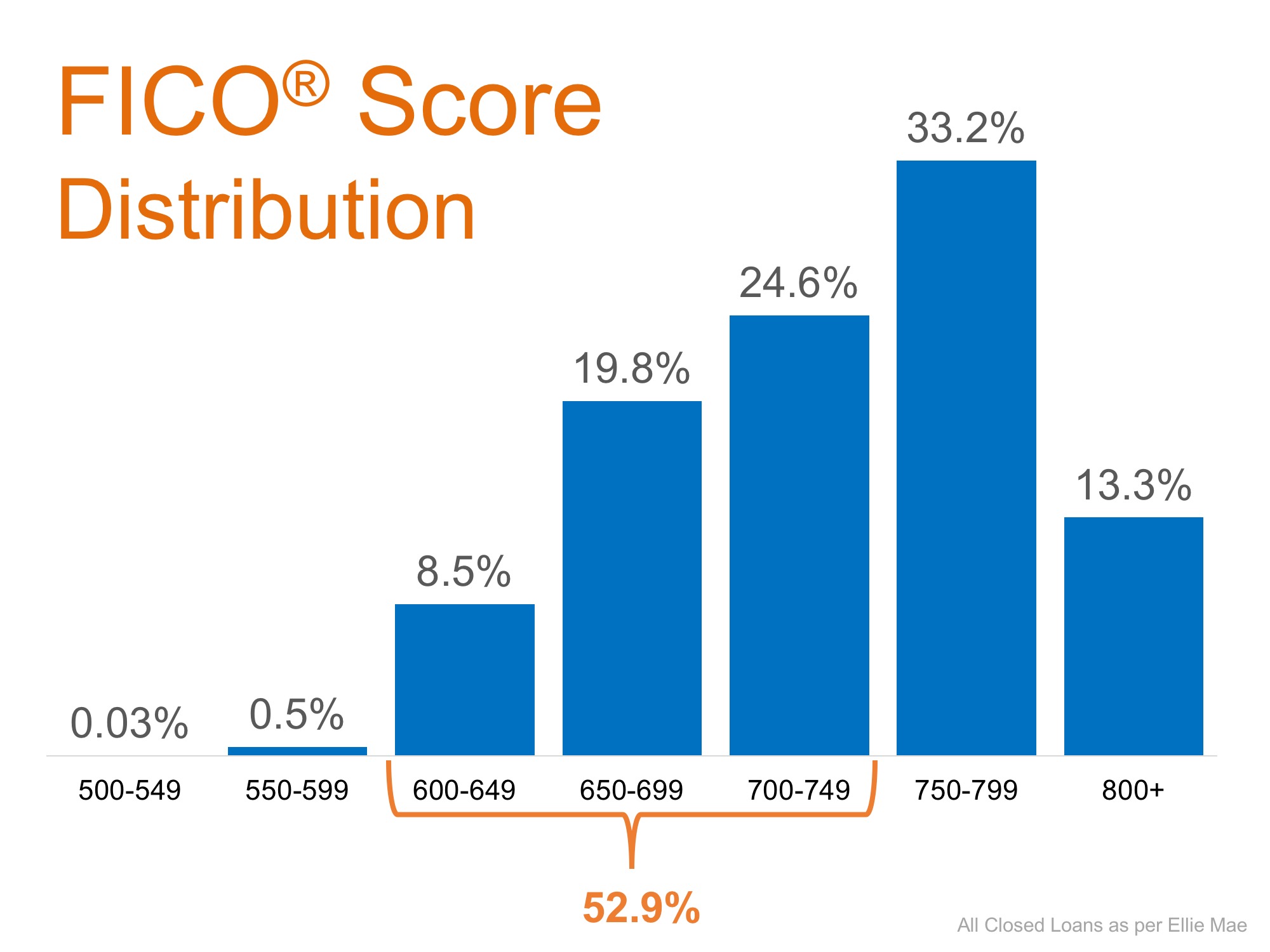
An Ipsos survey revealed that 62% of respondents believe they need excellent credit to buy a home, with 43% thinking a “good credit score” is over 780. In actuality, the average FICO® scores for approved conventional and FHA mortgages are much lower.

The average conventional loan closed in May had a credit score of 753, while FHA mortgages closed with an average score of 676. The average across all loans closed in May was 724. The chart below shows the distribution of FICO® Scores for all loans approved in May.

Bottom Line
If you are a prospective buyer who is ‘ready’ and ‘willing’ to act now, but you are not sure if you are ‘able’ to, let’s sit down to help you understand your true options today. 971.208.5093 or mcleodgroupoffice@gmail.com.

By: KCM Crew

Monday, April 16, 2018

Getting Pre-Approved Should Always Be Your First Step

In many markets across the country, the number of buyers searching for their dream homes greatly outnumbers the number of homes for sale. This has led to a competitive marketplace where buyers often need to stand out. One way to show you are serious about buying your dream home is to get pre-qualified or pre-approved for a mortgage before starting your search.
Even if you are in a market that is not as competitive, understanding your budget will give you the confidence of knowing if your dream home is within your reach.
Freddie Mac lays out the advantages of pre-approval in the ‘My Home’ section of their website:
“It’s highly recommended that you work with your lender to get pre-approved before you begin house hunting. Pre-approval will tell you how much home you can afford and can help you move faster, and with greater confidence, in competitive markets.”
One of the many advantages of working with a local real estate professional is that many have relationships with lenders who will be able to help you with this process. Once you have selected a lender, you will need to fill out their loan application and provide them with important information regarding “your credit, debt, work history, down payment and residential history.”
Freddie Mac describes the ‘4 Cs’ that help determine the amount you will be qualified to borrow:
1.    Capacity: Your current and future ability to make your payments
2.    Capital or cash reserves: The money, savings, and investments you have that can be sold quickly for cash
3.    Collateral: The home, or type of home, that you would like to purchase
4.    Credit: Your history of paying bills and other debts on time
Getting pre-approved is one of many steps that will show home sellers that you are serious about buying, and it often helps speed up the process once your offer has been accepted.

Bottom Line

Many potential home buyers overestimate the down payment and credit scores needed to qualify for a mortgage today. If you are ready and willing to buy, you may be pleasantly surprised at your ability to do so.

Contact your local experts at The McLeod Group Network for all your Real Estate needs! 971.208.5093 or mcleodgroupoffice@gmail.com.

By: KCM Crew

Monday, December 11, 2017

Why Getting Pre-Approved Should Be Your First Step

In many markets across the country, the number of buyers searching for their dream homes greatly outnumbers the number of homes for sale. This has led to a competitive marketplace where buyers often need to stand out. One way to show you are serious about buying your dream home is to get pre-qualified or pre-approved for a mortgage before starting your search.

Even if you are in a market that is not as competitive, knowing your budget will give you the confidence of knowing if your dream home is within your reach.

Freddie Mac lays out the advantages of pre-approval in the ‘My Home’ section of their website:

“It’s highly recommended that you work with your lender to get pre-approved before you begin house hunting. Pre-approval will tell you how much home you can afford and can help you move faster, and with greater confidence, in competitive markets.”

One of the many advantages of working with a local real estate professional is that many have relationships with lenders who will be able to help you with this process. Once you have selected a lender, you will need to fill out their loan application and provide them with important information regarding “your credit, debt, work history, down payment and residential history.” 

Freddie Mac describes the ‘4 Cs’ that help determine the amount you will be qualified to borrow:
  1. Capacity: Your current and future ability to make your payments
  2. Capital or cash reserves: The money, savings, and investments you have that can be sold quickly for cash
  3. Collateral: The home, or type of home, that you would like to purchase
  4. Credit: Your history of paying bills and other debts on time
Getting pre-approved is one of many steps that will show home sellers that you are serious about buying, and it often helps speed up the process once your offer has been accepted.
Bottom Line

Many potential home buyers overestimate the down payment and credit scores needed to qualify for a mortgage today. If you are ready and willing to buy, you may be pleasantly surprised at your ability to do so as well. Let’s get together - 971.208.5093 or mcleodgroupoffice@gmail.com

By: KCM Crew

Wednesday, November 1, 2017

Don't Let Fear Stop You from Applying for a Mortgage

Don't Let Fear Stop You from Applying for a Mortgage | MyKCM
A considerable number of potential buyers shy away from jumping into the real estate market due to their uncertainty about the buying process. A specific cause for concern tends to be mortgage qualification.

For many, the mortgage process can be scary, but it doesn’t have to be!

In order to qualify in today’s market, you’ll need to have saved for a down payment (73% of all buyers made a down payment of less than 20%, with many buyers putting down 3% or less), a stable income and good credit history.
Throughout the entire home buying process, you will interact with many different professionals, all of whom perform necessary roles. These professionals are also valuable resources for you.
Once you’re ready to apply, here are 5 easy steps that Freddie Mac suggests you follow:
  1. Find out your current credit history & score – even if you don’t have perfect credit, you may already qualify for a loan. The average FICO® Score of all closed loans in September was 724, according to Ellie Mae.
  2. Start gathering all your documentation – income verification (such as W-2 forms or tax returns), credit history, and assets (such as bank statements to verify your savings).
  3. Contact a professional – your real estate agent will be able to recommend a loan officer that can help you develop a spending plan, as well as determine how much home you can afford.
  4. Consult with your lender – he or she will review your income, expenses, and financial goals to determine the type and amount of mortgage you qualify for.
  5. Talk to your lender about pre-approval – a pre-approval letter provides an estimate of what you might be able to borrow (provided your financial status doesn’t change), and demonstrates to home sellers that you are serious about buying!

Bottom Line

Do your research, reach out to the professionals at The McLeod Group Network, stick to your budget, and be sure that you are ready to take on the financial responsibilities of becoming a homeowner. 971.208.5093 or mcleodgroupoffice@gmail.com
By: KCM Crew

Tuesday, October 10, 2017

No… You Do Not Need 20% Down to Buy NOW!

No… You Do Not Need 20% Down to Buy NOW! | MyKCM
The Aspiring Home Buyers Profile from the National Association of Realtors (NAR) found that the American public is still somewhat confused about what is required to qualify for a home mortgage loan in today’s housing market. The results of the survey show that non-homeowners cite the main reason for not currently owning a home, as not being able to afford one.
This brings us to two major misconceptions that we want to address today.

1. Down Payment

NAR’s survey revealed that consumers overestimate the down payment funds needed to qualify for a home loan. According to the report, 39% of non-homeowners say they believe they need more than 20% for a down payment on a home purchase. In actuality, there are many loans written with a down payment of 3% or less.
Many renters may actually be able to enter the housing market sooner than they ever imagined with new programs that have emerged allowing less cash out of pocket.

2. FICO® Scores

An Ipson survey revealed that 62% of respondents believe they need excellent credit to buy a home, with 43% thinking a “good credit score” is over 780. In actuality, the average FICO® scores of approved conventional and FHA mortgages are much lower.
The average conventional loan closed in August had a credit score of 752, while FHA mortgages closed with a score of 683. The average across all loans closed in August was 724. The chart below shows the distribution of FICO® Scores for all loans approved in August.
No… You Do Not Need 20% Down to Buy NOW! | MyKCM

Bottom Line

If you are a prospective buyer who is ‘ready’ and ‘willing’ to act now, but are not sure if you are ‘able’ to, let’s sit down to help you understand your true options. 971.208.5093 or mcleodgroupoffice@gmail.com
By: KCM Crew

Wednesday, August 30, 2017

Number of Buyers Putting Down Less Than 10% Hits 7-Year High

Number of Buyers Putting Down Less Than 10% Hits 7-Year High | MyKCM
According to Black Knight Financial Service’s Mortgage Monitor Report, 1.5 million Americans have purchased a home with down payments under than 10% over the last 12 months. This is great news for buyers as this marks a 7-year high.
Many mortgage programs offered by agencies like Freddie Mac and Fannie Mae allow buyers to put down as low as 3% to purchase their dream homes. The strength of the housing market has aided buyers who used low-down-payment programs to buy. As a recent CNBC article points out,
“Defaults on recent low down payment loans, so far, are slow, but that is as much a factor of the good credit quality as it is the strength of the housing market. Home prices are rising incredibly fast, meaning those borrowers are gaining equity in their homes quickly.”
Low down payments aren’t just great for first-time homebuyers. These programs have allowed homeowners who want to capitalize on the equity they have in their homes to use the profit from their sale to pay off high-interest credit cards, fund education or even start a business.
According to a new Census Report, the Annual Survey of Entrepreneurs, home equity was used to start 7.3% of all businesses in the United States, which equates to over 284,000! The industries that saw the most growth from home equity are accommodation & food services, manufacturing and, retail trade.

Bottom Line

Gone are the days of ‘20% down or no mortgage.’ What could you build with the equity in your house? Let’s get together to evaluate your ability to achieve your dreams today! 971.208.5093 or mcleodgroupoffice@gmail.com 
By: KCM Crew

Tuesday, June 27, 2017

Pre-Approval Should Always Be Your First Step

In many markets across the country, the number of buyers searching for their dream homes greatly outnumbers the amount of homes for sale. This has led to a competitive marketplace where buyers often need to stand out. One way to show you are serious about buying your dream home is to get pre-qualified or pre-approved for a mortgage before starting your search.
Even if you are in a market that is not as competitive, knowing your budget will give you the confidence of knowing if your dream home is within your reach.
Freddie Mac lays out the advantages of pre-approval in the My Home section of their website:
“It’s highly recommended that you work with your lender to get pre-approved before you begin house hunting. Pre-approval will tell you how much home you can afford and can help you move faster, and with greater confidence, in competitive markets.”
One of the many advantages of working with a local real estate professional is that many have relationships with lenders who will be able to help you with this process. Once you have selected a lender, you will need to fill out their loan application and provide them with important information regarding “your credit, debt, work history, down payment and residential history.” 
Freddie Mac describes the 4 Cs that help determine the amount you will be qualified to borrow:
  1. Capacity: Your current and future ability to make your payments
  2. Capital or cash reserves: The money, savings, and investments you have that can be sold quickly for cash
  3. Collateral: The home, or type of home, that you would like to purchase
  4. Credit: Your history of paying bills and other debts on time
Getting pre-approved is one of many steps that will show home sellers that you are serious about buying, and it often helps speed up the process once your offer has been accepted.

Bottom Line

Many potential home buyers overestimate the down payment and credit scores needed to qualify for a mortgage today. If you are ready and willing to buy, contact McLeod Group Network, you may be pleasantly surprised at your ability to do so as well. 971.208.5093 or mcleodgroupoffice@gmail.com. 

Monday, April 24, 2017

How Fast Can You Save for a Down Payment?


How Fast Can You Save for a Down Payment? | Keeping Current Matters
Saving for a down payment is often the biggest hurdle for a first-time homebuyer. Depending on where you live, median income, median rents, and home prices all vary. So, we set out to find out how long would it take you to save for a down payment in each state?
Using data from the United States Census Bureau and Zillow, we determined how long it would take, nationwide, for a first-time buyer to save enough money for a down payment on their dream home. There is a long-standing ‘rule’ that a household should not pay more than 28% of their income on their monthly housing expense.
By determining the percentage of income spent renting a 2-bedroom apartment in each state, and the amount needed for a 10% down payment, we were able to establish how long (in years) it would take for an average resident to save enough money to buy a home of their own.
According to the data, residents in Iowa can save for a down payment the quickest in just under 2 years (1.99). Below is a map created using the data for each state:
How Fast Can You Save for a Down Payment? | Keeping Current Matters

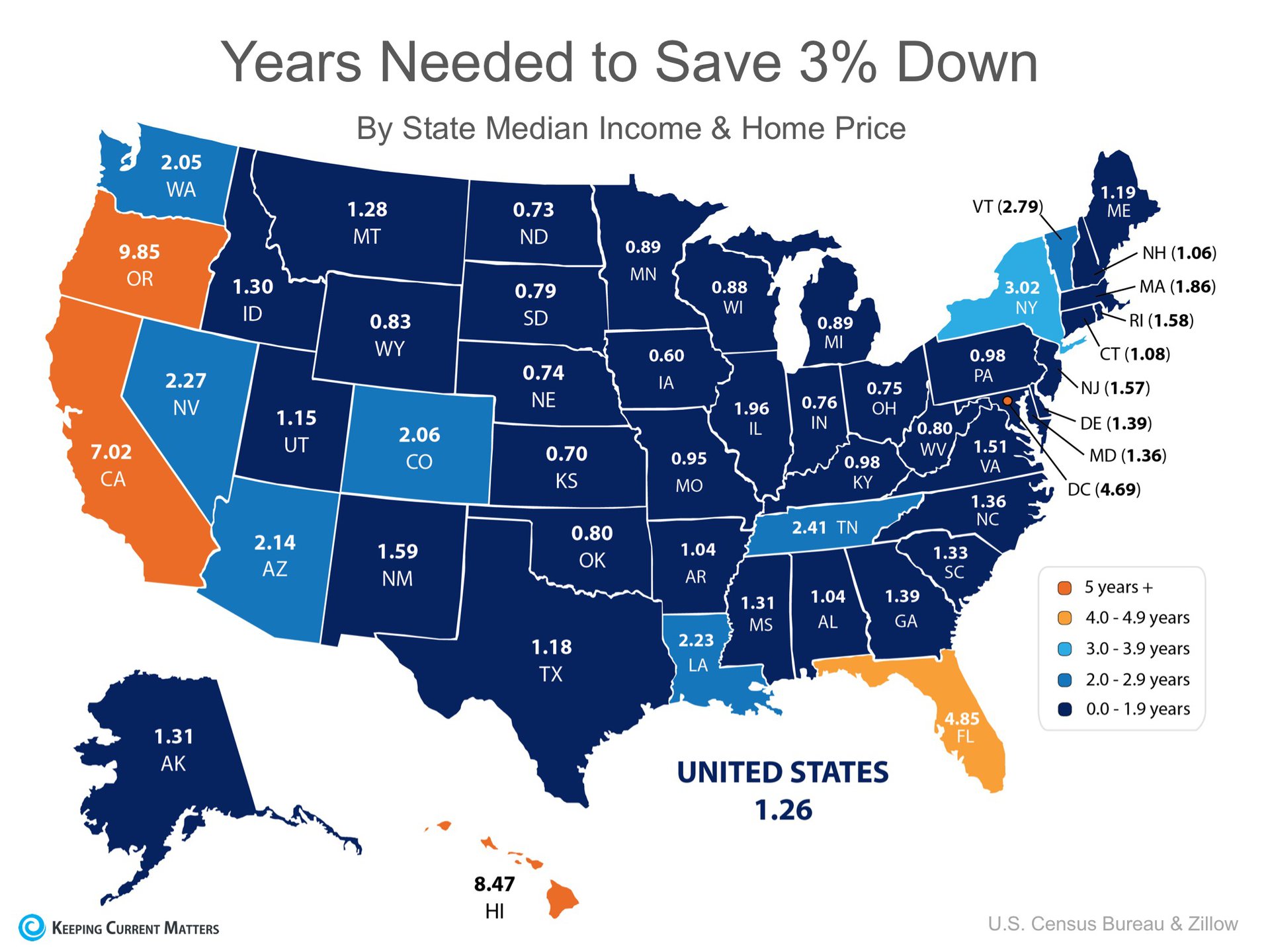
What if you only needed to save 3%?

What if you were able to take advantage of one of Freddie Mac’s or Fannie Mae’s 3% down programs? Suddenly, saving for a down payment no longer takes 5 or 10 years, but becomes attainable in a year or two in many states as shown in the map below.
How Fast Can You Save for a Down Payment? | Keeping Current Matters

Bottom Line

Whether you have just begun to save for a down payment, or have been saving for years, you may be closer to your dream home than you think! Let The McLeod Group Network help you evaluate your ability to buy today. 971.208.5093 or mcleodgroupoffice@gmail.com.